February Blog
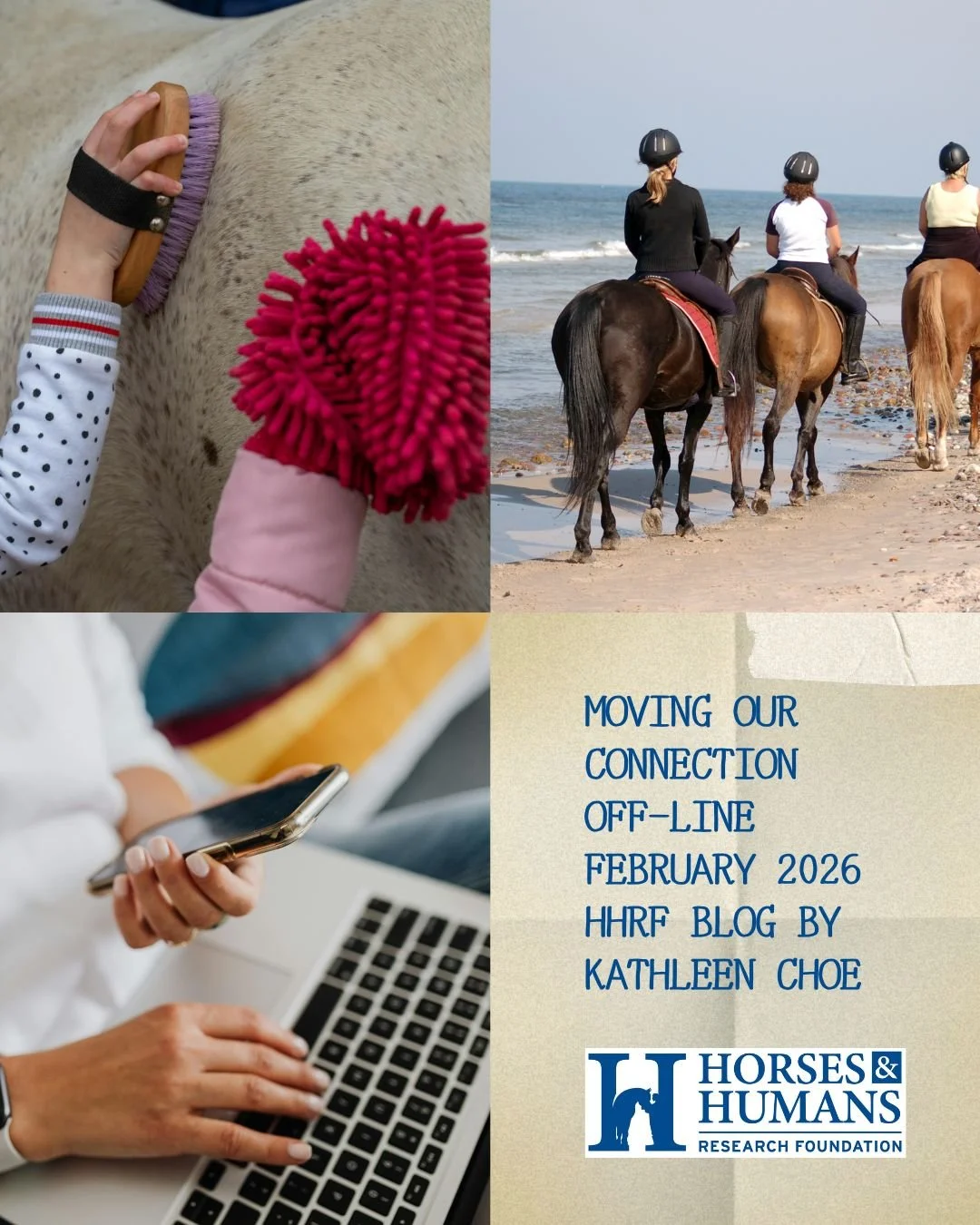
Moving Our Connection Off-Line
February 2026 HHRF blog by Kathleen Choe
When a frightening new and deadly virus began making headlines in the spring of 2020, we uneasily started moving away from being around people outside of our immediate families or living situations, not knowing how the virus was spread and fearing contracting it with no treatment or vaccine yet in sight. We interfaced through our screens, and if we had to be out in public, practiced social distancing, wearing masks and gloves and other safety equipment. It was a time of fear and uncertainty, and both the lack of accurate information as well as burgeoning misinformation only compounded the chaos we were all experiencing. Schools, churches, libraries, shopping malls, and other communal gathering places shut their doors. Children logged onto their computers to see their classmates and teachers pixelated on a screen. As a therapist, I moved all of my clients to telehealth at first and was thus invited into their homes in a strangely intimate way that would not have been possible without some potentially serious boundary crossings prior to this. Clients huddled in closets and on stairwells and in their cars to find some privacy for their counseling sessions with me, but often children, pets, and partners passed through in the background, or popped up on the screen, curious and eager to say hello.
As information became more clear on how the virus was spread, and what helped to prevent it, I cautiously began meeting with clients again at the farm so they could work with their equine partner for their Equine Assisted Psychotherapy sessions. We practiced social distancing and wore masks, and I religiously wiped down halters, brushes, gates, and even the horses’ noses if they had been touched by their human friend. I went through gallons of hand sanitizer and bleach trying to keep everyone safe, but all of the effort these precautionary measures required became so worth it when I heard my clients say things like, “you’re the only human being I see in person all week,” and “I so look forward to being physically present with you and the horses, and touching a living being without being afraid.”
In fact, research shows that while on screen connections are better than isolation, a great deal is lost when people stop gathering in person to converse and connect.[1] The “feel good” neurotransmitters like oxytocin, dopamine and serotonin released in our bodies when we connect safely and meaningfully with another live being cannot be matched by the more limited connection that is possible when not physically sharing the same space. We are literally looking at pixels of each other, and missing many of the nuanced non-verbal cues like micro-expressions and other forms of body language that help to inform and deepen our understanding of our verbal exchanges.
The research is clear that meeting online is better than not meeting at all, and it certainly was a necessity during the pandemic, but many formerly live gatherings have remained online despite the option to go back to meeting in person. Therapy and support groups, AA meetings, educational courses and workshops and other offerings remain in an online format, or in a hybrid format like church services which can be attended in person or watched via live streaming, which is certainly more convenient and increases accessibility by allowing people farther away geographically or with mobility and transportation challenges to participate, but we also lose so many important benefits when we are only seeing each other on screens and not sharing space together in person.
The multitude of benefits connecting in person provides are just another wonderful reason to come to the HHRF annual conference in February in Kissimmee, Florida. It is definitely worth the time, effort, money, and travel to gather with others in the EAS field, who are eager to learn and grow together. You will connect with old friends and make many new ones. Your body, brain and heart will certainly thank you, and with your newfound knowledge and improved skill sets, your horse will too!
[1] Nathan Liang, Samantha J. Grayson, Mia A. Kussman, Judith N. Mildner, Diana I. Tamir,
In-person and virtual social interactions improve well-being during the COVID-19 pandemic,
Computers in Human Behavior Reports, Volume 15, 2024,100455, ISSN 2451-9588,
https://doi.org/10.1016/j.chbr.2024.100455.
(https://www.sciencedirect.com/science/article/pii/S2451958824000885)