The Healing Power of Horses: How Equines Support Our Well-Being
By: Dr. Helen Sharp and Dr. Pebbles Turbeville
Horses have walked alongside humans for thousands of years—plowing our fields, carrying our burdens, and more recently, helping to heal our minds and bodies. But did you know that horses can also support your overall wellness, from emotional health to physical fitness and even your sense of purpose?
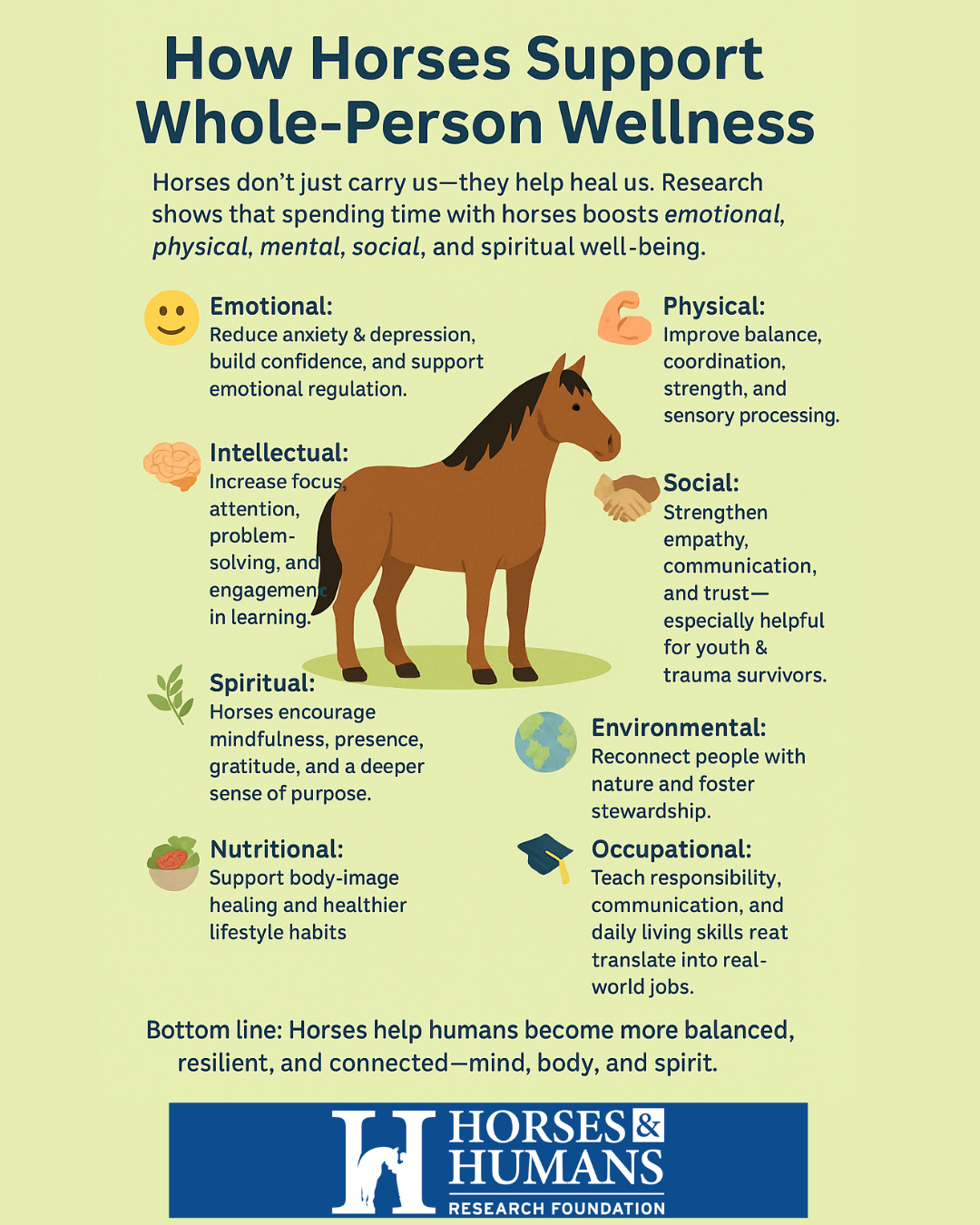
Wellness is more than just not being sick. It is about thriving in all aspects: emotionally, physically, mentally, socially, and spiritually. Experts often describe wellness in eight dimensions: Emotional, Physical, Intellectual, Social, Spiritual, Environmental, Occupational, and Nutritional. By examining how horses fit into each of these areas, we can gain a deeper understanding of the holistic benefits of spending time with these incredible animals.
Emotional Wellness
Emotional wellness is about understanding and managing your feelings, coping with stress, and building emotional resilience. Many people who work with horses, whether in therapy sessions or recreational programs, report feeling calmer, more confident, and more in control of their emotions.
- Lower Anxiety and Depression: People of all ages have experienced significant reductions in anxiety and depression after participating in equine-assisted therapy [1].
- Higher Self-Esteem: Caring for and riding horses helps build confidence and self-efficacy, especially in children and teens [2].
- Better Emotional Regulation: Veterans and trauma survivors have shown improvements in emotional awareness and mindfulness through horse interactions [3][4].
- Healthy Attachment and Connection: The horse-human bond fosters feelings of trust and connection, which is especially valuable for individuals with trauma or attachment challenges [5].
Physical Wellness
This involves taking care of your body through movement, sleep, nutrition, and healthcare. Riding and caring for horses is not just emotionally fulfilling—it is physically beneficial too.
- Improved Balance and Coordination: Therapies like hippotherapy have been shown to improve posture and balance in people with neurological conditions [6].
- Stronger Muscles: Keeping your body upright on a moving horse helps strengthen your core and back muscles [7][8].
- Enhanced Sensory Processing: Riding engages multiple senses, which can be especially helpful for individuals with autism or sensory disorders [9].
Intellectual Wellness
This is about staying mentally active and continuously learning. Horse-related activities challenge the mind in many ways:
- Increased Focus and Attention: Horseback riding can improve concentration and reduce impulsivity, especially in children with ADHD [10][11].
- Better Memory and Executive Functioning: Planning, following instructions, and adjusting to real-time feedback during riding all support mental agility [12][13].
- Engagement in Learning: Students involved in equine-assisted learning often become more focused and engaged in school [14].
Social Wellness
Social wellness means building healthy relationships and feeling connected to others. Horses act as social facilitators, helping people improve how they relate to others:
- Improved Social Skills in Autism: Horse programs help children on the autism spectrum improve communication and reduce behavioral challenges [14][15].
- Increased Empathy and Teamwork: Youth in equine programs often show greater empathy, cooperation, and emotional regulation [16][17].
- Support for Trauma Survivors: Equine-assisted therapy creates a safe space to rebuild trust and connection with others [18].
Spiritual Wellness
Spiritual wellness is about finding meaning and purpose in life—it may or may not involve religion. Spending time with horses in natural settings can be deeply spiritual:
- Mindfulness and Presence: Horses live in the moment and encourage humans to do the same, promoting mindfulness [19].
- Awe and Gratitude: Their size, sensitivity, and honesty often stir feelings of wonder and appreciation [20].
- Exploring Meaning and Identity: Equine programs help people reflect on their values, purpose, and spiritual beliefs—especially those recovering from trauma or illness [21][22].
Environmental Wellness
This focuses on respecting and connecting with the natural world. Being around horses encourages a stronger relationship with the environment:
- Nature Connection: Horse programs often take place outdoors, helping people reconnect with the rhythms of nature [23][24].
- Stewardship and Sustainability: Equine care can include learning about eco-friendly land use, composting, and animal welfare [25][26].
- Therapeutic Green Spaces: Riding through forests or open fields boosts well-being and helps combat “nature deficit disorder” [27][28][29].
Occupational Wellness
Occupational wellness is about finding satisfaction and purpose in your work or daily roles. Horse-assisted activities can lead to both personal fulfillment and practical skill-building:
- Improved Daily Functioning: Activities like grooming and riding support coordination, planning, and routine-building [30].
- Job Skills: Working with horses teaches responsibility, communication, and time management—skills that apply in many jobs [30].
- Career Development: Many people go on to volunteer, mentor, or work in equine-related fields like therapy, vet care, or animal training [30].
Nutritional Wellness
This involves building a healthy relationship with food and making nourishing choices for your body. You might not expect horses to support this area—but they do!
- Improved Body Image: People recovering from eating disorders report that horses help them feel more connected to and accepting of their bodies [31][33].
- Support for Recovery: Taking care of horses can boost motivation to eat and stay strong, especially during recovery from anorexia or bulimia [32][34].
- Healthier Lifestyle Habits: Participants in equine programs often adopt other healthy habits, including better nutrition [33].
- Agricultural Education: Youth learn about food systems, nutrition, and sustainable eating [26].
- Movement Supports Nutrition: Physical activity through riding helps regulate appetite and supports metabolism [6][7].
Horses offer more than a beautiful ride through the countryside—they support human wellness across emotional, physical, mental, social, and spiritual dimensions. Whether through structured therapy or simply spending time at the stable, equine interactions provide opportunities for healing, growth, and connection. Next time you are near a horse, take a moment to appreciate the quiet, powerful ways they help us become more balanced, resilient, and whole.
References
1. Bachi, K., Terkel, J. and Teichman, M., 2012. Equine-facilitated psychotherapy for at-risk adolescents: The influence on self-image, self-control, and trust. Clinical Child Psychology and Psychiatry, 17(2), pp.298–312. https://doi.org/10.1177/1359104511404177
2. Burgon, H., 2011. ’Queen of the world’: Experiences of ‘at-risk’ young people participating in equine-assisted learning/therapy. Journal of Social Work Practice, 25(2), pp.165–183. https://doi.org/10.1080/02650533.2011.561304
3. Johnson, R.A. et al., 2018. Effects of therapeutic horseback riding on post-traumatic stress disorder in military veterans. Military Medical Research, 5(1), p.3. https://doi.org/10.1186/s40779-018-0159-9
4. Lanning, B.A. and Krenek, N., 2013. Examining effects of equine-assisted activities to help combat veterans improve quality of life. Journal of Rehabilitation Research and Development, 50(8), pp.xix–xxvi. https://doi.org/10.1682/JRRD.2012.01.0002
5. Klontz, B.T. et al., 2007. The effectiveness of equine-assisted experiential therapy: Results of an open clinical trial. Society and Animals, 15(3), pp.257–267. https://doi.org/10.1163/156853007X217195
6. Silkwood-Sherer, D.J. et al., 2012. Hippotherapy–An intervention to habilitate balance deficits in children with movement disorders: A clinical trial. Physical Therapy, 92(5), pp.707–717. https://doi.org/10.2522/ptj.20110090
7. Lechner, H.E. et al., 2007. The effect of hippotherapy on spasticity and on mental well-being of persons with spinal cord injury. Archives of Physical Medicine and Rehabilitation, 88(10), pp.1241–1248. https://doi.org/10.1016/j.apmr.2007.06.016
8. Herrero, P. et al., 2010. Study of the therapeutic effects of an advanced hippotherapy simulator in children with cerebral palsy: A randomized controlled trial. BMC Musculoskeletal Disorders, 11(71). https://doi.org/10.1186/1471-2474-11-71
9. Ward, S.C. et al., 2013. The association between therapeutic horseback riding and the social communication and sensory reactions of children with autism. Journal of Autism and Developmental Disorders, 43, pp.2190–2198. https://doi.org/10.1007/s10803-013-1773-3
10. Shurtleff, T.L., Standeven, J.W. and Engsberg, J.R., 2009. Changes in dynamic trunk/head stability and functional reach after hippotherapy. Archives of Physical Medicine and Rehabilitation, 90(7), pp.1185–1195. https://doi.org/10.1016/j.apmr.2009.01.027
11. Gabriels, R.L. et al., 2012. Pilot study measuring the effects of therapeutic horseback riding on school-age children and adolescents with autism spectrum disorders. Research in Autism Spectrum Disorders, 6(2), pp.578–588. https://doi.org/10.1016/j.rasd.2011.09.007
12. Bachi, K., 2013. Application of attachment theory to equine-facilitated psychotherapy. Society and Animals, 21(4), pp.364–380. https://doi.org/10.1163/15685306-12341262
13. McDaniel Peters, B.C. and Wood, W., 2017. Autism and equine-assisted interventions: A systematic mapping review. Journal of Autism and Developmental Disorders, 47, pp.3220–3242. https://doi.org/10.1007/s10803-017-3219-9
14. Gabriels, R.L. et al., 2015. Randomized controlled trial of therapeutic horseback riding in children and adolescents with autism spectrum disorder. Journal of the American Academy of Child and Adolescent Psychiatry, 54(7), pp.541–549. https://doi.org/10.1016/j.jaac.2015.04.007
15. Lanning, B.A. et al., 2014. Effects of equine-assisted activities on autism spectrum disorder. Journal of Autism and Developmental Disorders, 44, pp.1897–1907. https://doi.org/10.1007/s10803-014-2062-5
16. Pendry, P. and Roeter, S.M., 2013. Experimental trial demonstrates positive effects of equine facilitated learning on child social competence. Human-Animal Interaction Bulletin, 1(1), pp.1–19.
17. Pendry, P., Smith, A.N. and Roeter, S.M., 2014. Randomized trial examines effects of equine facilitated learning on adolescents’ basal cortisol levels. Human-Animal Interaction Bulletin, 2(1), pp.80–95.
18. Kemp, K. et al., 2014. Equine facilitated therapy with children and adolescents who have been sexually abused: A program evaluation study. Journal of Child and Family Studies, 23, pp.558–566. https://doi.org/10.1007/s10826-013-9718-1
19. Trotter, K.S. et al., 2008. A comparative study of the efficacy of group equine assisted counseling with at-risk children and adolescents. Journal of Creativity in Mental Health, 3(3), pp.254–284. https://doi.org/10.1080/15401380802356880
20. Hart, L.A. and Yamamoto, M., 2015. Equine-assisted therapy and psychotherapy: Roles, effectiveness, and insights. In: Fine, A.H. (ed.), Handbook on Animal-Assisted Therapy, 4th ed. Elsevier, pp.131–147. https://doi.org/10.1016/B978-0-12-801292-5.00010-6
21. Lentini, J.A. and Knox, M., 2009. A qualitative and quantitative review of equine facilitated psychotherapy (EFP) with children and adolescents. The Open Complementary Medicine Journal, 1, pp.51–57. https://doi.org/10.2174/1876391X00901010051
22. Johnson, R.A. and Albright, D.L., 2019. Effects of therapeutic horseback riding on post-traumatic stress disorder in military veterans. Military Medical Research, 6(1), pp.1–8. https://doi.org/10.1186/s40779-019-0207-3
23. Haylock, S. and Cantrill, A., 2006. Equine-assisted therapy: Harnessing solutions for people and the environment. Counselling and Psychotherapy Journal, 17(1), pp.25–28.
24. Yorke, J., Adams, C. and Coady, N., 2008. Therapeutic value of equine–human bonding in recovery from trauma. Anthrozoös, 21(1), pp.17–30. https://doi.org/10.2752/089279308X274038
25. Thompson, K. and Nesci, C., 2016. From animals in the sport of kings to animals in need of rescue: The evolving role of horses in Australian society. Society and Animals, 24(1), pp.81–100. https://doi.org/10.1163/15685306-12341381
26. Arnold, M.E. et al., 2009. The impact of 4-H youth development programs on responsibility, connection, and caring: 4-H study of positive youth development. Oregon State University Extension Service.
27. Berget, B., Ekeberg, Ø. and Braastad, B.O., 2008. Animal-assisted therapy with farm animals for persons with psychiatric disorders: Effects on self-efficacy, coping ability and quality of life. Clinical Practice and Epidemiology in Mental Health, 4, p.9. https://doi.org/10.1186/1745-0179-4-9
28. Louv, R., 2008. Last Child in the Woods: Saving Our Children from Nature-Deficit Disorder. Chapel Hill, NC: Algonquin Books.
29. Henshall, C. et al., 2022. Human–animal relationships in equine-assisted therapy: Advocating for mutual well-being. People and Nature, 4(1), pp.124–137. https://doi.org/10.1002/pan3.10257
30. Tetreault, A., 2006. Horses that heal. [Details missing – please confirm publication info].
31. Prevalence of Eating Disorder Risk and Body Image Distortion in Collegiate Equestrian Athletes. Journal of Athletic Training (PMC). https://pmc.ncbi.nlm.nih.gov/articles/PMC3419156
32. Equine Therapy in the Management of Teenagers with Anorexia: A Multiple Case Study. Eating and Weight Disorders – Studies on Anorexia, Bulimia and Obesity. Springer. https://link.springer.com/article/10.1007/s40519-025-01724-5
33. Potential Impacts of Body Image Perception in Female Equestrians. Journal of Equine Veterinary Science. ScienceDirect. https://www.sciencedirect.com/science/article/abs/pii/S0737080621004068
34. Equestrian Vaulting as an Innovative Complementary Intervention in Eating Disorder Treatment. Frontiers in Psychology. PMC. https://pmc.ncbi.nlm.nih.gov/articles/PMC9471095