
June Blog
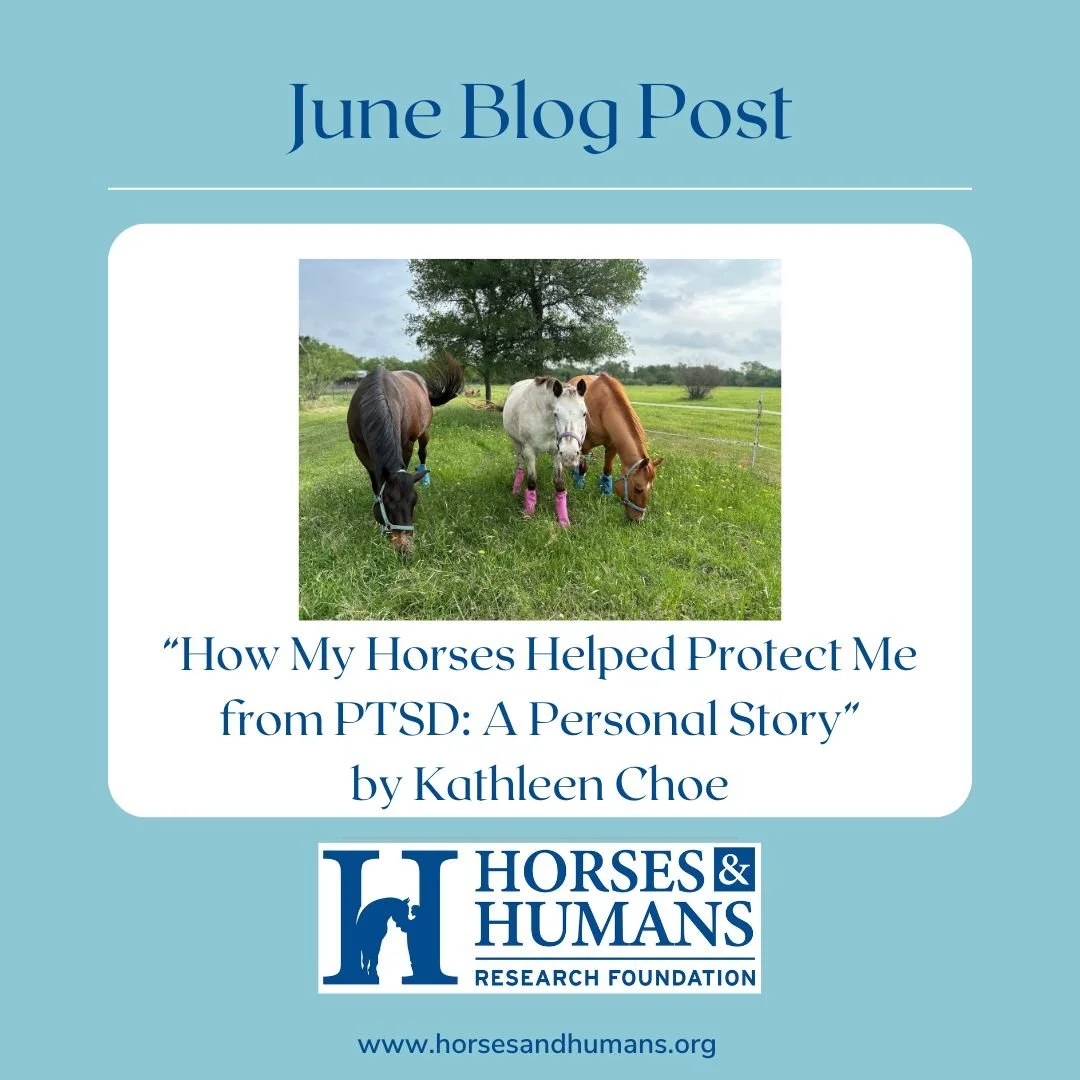
My equine helpers: Sterling, Spirit, and Copper
Every month in my blogs, I try to highlight the national awareness focus for that month and share information and research about how horse-human interactions relate to this theme. June is national Post Traumatic Stress Disorder (PTSD) Awareness month and I want to share a more personal story this time. The term “PTSD” first appeared in 1980 in the third edition of the Diagnostic and Statistical Manual of Mental Disorders. However, earlier medical publications referred to conditions described as “soldier’s heart,” “shell shock,” and “war neurosis” to describe the disturbed state in which many soldiers returned from combat. With the prevalence of PTSD in the military community, it is not surprising that the effort to create awareness was launched as a tribute to a service member. On June 27, 2010, PTSD Awareness Day was established in recognition of Staff Sergeant, Joe Biel, a National Guard service member who experienced PTSD after two tours in Iraq and died by suicide in 2007. In 2014, the federal government designated the entire month of June as PTSD Awareness Month.
PTSD is a syndrome of psychological and physiological responses that can follow an event (or a series of events) that a person found threatening to their life, or to their physical and mental safety. A person with PTSD is going to struggle with intense emotional responses, re-experiencing the trauma (such as flashbacks or nightmares), avoidance of things that remind them of what happened (such as smells, noises, places), and feeling hyper-arousal (e.g., monitoring their surroundings, being much jumpier than their friends). In order to de-pathologize this condition, and because these symptoms are understandable reactions to suffering traumatic events, there is a movement to remove the word “disorder” from this condition and re-label it as “Post Traumatic Stress.”
Historically PTSD has been understood as a result of military service and combat, but it can occur after any traumatic event, such as a car accident, natural disaster, prolonged abuse, or any type of violence, which is what I experienced while out for a run in my neighborhood.
I live in the suburbs of Austin, Texas, in what is considered a relatively safe neighborhood. In my area, the most prevalent crimes amount to porch pirates stealing Amazon deliveries, although this has never happened to me personally. But several years ago, there was a predator preying on female runners in the city. The attacks were mostly happening fairly far from where I live, so I continued to practice my usual safety precautions while out running in the early mornings before work. I was toiling up a rather steep hill several miles from my house when I heard heavy breathing and footsteps behind me. I happened to be on a very narrow sidewalk with a tall hedge on one side and a guard rail on the other at this point in my run. Normally, I run in the street next to the curb, facing traffic, but school buses have been known to hug this corner rather tightly, and after almost getting taken out by one such bus I started running on the sidewalk on this particular stretch of the road. I turned sideways to let the runner pass as it appeared he was running at a faster clip than I was. It took my brain several seconds to realize that this person had no intention of passing me, but was actually pursuing me. As he caught up to me, he proceeded to grab me by my shoulders and tried to throw me to the ground.
Due to the increasing number of attacks, the Austin Police Department had recently released a public service announcement outlining the acronym “S.I.N.G.” as a way to remember how to resist an assailant: (1) Solar Plexus: A strike or palm-heel to the stomach to knock the wind out of them; (2) Instep: A hard stomp on the attacker's foot to break their balance; (3) Nose: A jab or strike to the nose to cause extreme disorientation and tearing; and (4) Groin: A quick kick or knee strike to temporarily incapacitate your opponent. (This acronym was also made famous by Sandra Bullock’s character, Gracie Hart, in the movie Miss Congeniality). Additionally, we were encouraged to yell for help as loudly as possible. In my shock and surprise at this turn of events, I managed to remember to stomp on his foot while bringing my knee up towards his groin, and screaming for help. The man shoved me backwards in surprise, and I must have lost consciousness because the next thing I remember is a voice screaming at me: “Get up! Get up now! You have to get up and run away!” I realized the voice was inside my head. My brain was literally yelling at me to mobilize.
I was dizzy and disoriented from hitting the pavement so hard, but I managed to sit up and crawl to my knees and then back onto my feet, stumbling up the hill in the direction I had originally been going, while my eyes frantically darted around to see if my attacker was coming after me again. I saw a woman running down the hill towards me, and I tried to warn her to stop and turn around, but my voice didn’t seem to be working. She stopped in front of me and said, “Are you OK? You’re bleeding!” I did not realize this and couldn’t really process what she was saying to me. I kept trying to tell her we needed to get away from here because there was someone who wanted to harm us nearby. She put her arm around me and led me to her home which was just up the street. She called 911 and gave me a glass of water and a towel to stop the blood that was running down the back of my head and my neck. She kept asking me what happened and I told her that someone had thrown me to the ground, but I couldn’t remember anything else.
At the hospital a Counselor from Victim’s Services came to talk to me. “I fought back this time!” I told her proudly. My head was beginning to clear a bit, although it was still throbbing and very sore from hitting the pavement so hard. “Was there another time?” she asked gently. “Yes,” I said. “I was assaulted in a public restroom in Golden Gate Park in San Francisco years ago and I just froze. I couldn’t scream or fight back or anything. I felt so helpless. This time I fought back!”
She said, “Sometimes the freeze response is the best way to keep yourself safe. One response is not better than the other, although fighting back can feel more empowering.” As a therapist myself, I knew she was right. The freeze response just feels so helpless and disempowering and it is why victims often get blamed for being harmed. “Why didn’t you fight back?” people ask. “Why didn’t you scream louder? Why didn’t you try to get help?”
There are basically four responses our brain can have to a traumatic event: fight, flight, freeze or fawn. Our brain stem decides which response to choose, and it chooses the one that seems most likely to keep us alive in that moment. We are not able to access the executive functioning part of our brain when we are triggered by an event that threatens our life or the life of someone else. Our brainstem takes over and reacts before our neocortex has a chance to catch up with rational thought. This is a very helpful survival mechanism, because if we took the time to think about what make and model of car was careening towards us going the wrong direction in our lane on the highway at top speed, we might not simply yank the wheel to get out of the way in time. In survival mode, our brain screens out irrelevant information and just focuses on how to keep us alive in that very moment in time.
Not everyone develops PTSD after a traumatic event. It is normal to have stress reactions including upsetting memories, feeling on edge, or having trouble sleeping after experiencing a life threatening emergency. If symptoms exist for longer than a few months, a person may be diagnosed with PTSD. The three factors that seem to result in developing PTSD after a trauma are feeling helpless and overwhelmed, somehow responsible for what happened, and feeling alone during and after the crisis. The level of validation, acknowledgment and support someone receives after a traumatic incident can be a protective buffer against PTSD. Thankfully, as a result of the amount of support I received following my attack, my trauma symptoms did not develop into a full-blown case of PTSD. Spending time with horses, both in my capacity as an Equine Assisted Psychotherapist, and also on my own, became a significant part of my healing. Their wise, gentle, accepting presence was a balm to my fearful and reactive nervous system. They did not see or treat me any differently, but held space for the times that I needed to cry or talk about what happened to me when I was sure everyone else was tired of hearing me process it. They carried me gently on their backs, rocking and regulating my nervous system with their rhythmic movement. They were not overwhelmed or uncomfortable with the details of my story or my sometimes intense emotions.
Research consistently validates and confirms the efficacy of therapies involving horses in the treatment of mental health conditions like PTSD. [i] I have witnessed the truth of this countless times over in my Equine Assisted Psychotherapy practice, as well as in my own life.
We must keep working to find ways to help people with PTSD heal from their trauma and be able to live full and meaningful lives. Partnering with horses in this effort is an evidence-based way forward towards this goal!
[i] Nora Palomar-Ciria, Hugo J Bello, Equine-Assisted Therapy in Post-Traumatic-Stress Disorder: A Systematic Review and Meta-Analysis, Journal of Equine Veterinary Science, Volume 128, 2023, 104871, ISSN 0737-0806, https://doi.org/10.1016/j.jevs.2023.104871.