

The dictionary defines “transition” as “a change or shift from one state, subject, or place to another.” I experienced this quite literally when I relocated along with my husband, our Great Pyrenees rescue dog, and two quarter horses from Texas to Washington over the summer. We went from a relatively flat, hot, arid landscape to one with tall mountains, lush forests, extensive waterways (sometimes requiring ferry crossings to get where you want to go) and yes, much more rain, though that has yet to occur (I am assured by locals that the precipitation will start soon and not cease until next spring sometime!) After spending thirty years in Texas: raising a family, building a network of clients and colleagues through my therapy practice, and making deep roots in our neighborhood and community, starting over in a new part of the country required many more adjustments than the obvious landscape and climate differences.
Major life transitions, such as moving, graduating from an educational program, getting married or starting a family are major milestones that may be eagerly anticipated and viewed as positive developments, but even these can trigger significant stress, as they come with shifts in one’s sense of identity, routines, responsibilities and support systems. We lose the rhythm of life as something known and familiar and face the uncertainty and unpredictability that comes with change. These adjustments can be as minor as finding a new hairdresser (which may feel major to some!) or more taxing (and expensive) like discovering, (fortunately BEFORE I moved my horses) that a good number of the trees growing in my horse pasture were toxic to equines and had to be removed.
As mammals, both humans and horses are wired to prefer predictability in their environments. Developing predictable routines conserves mental energy, helps anticipate outcomes, and promotes security. Who hasn’t been late to the barn to feed only to find their horses anxiously stamping and snorting as they wonder what happened to their breakfast? Yet as horses change hands due to outliving their perceived usefulness for any given career, or becoming difficult to handle, or expensive to maintain, or their current owner moves them to a new stable; they are routinely exposed to one of the most disruptive transitions of all, requiring them to adjust to a new location with all the changes that entails in terms of surroundings, routines, handlers, and herd mates.
Whether horses grieve seems to be up for debate, and more research is needed on this subject, but I have personally witnessed one of my horse’s deeply mourn the loss of an equine friend, and have heard similar stories from others. As sentient beings capable of forming attachments, when these are ruptured it makes sense that horses would experience distress. What the research does robustly show is that transition stress greatly affects horses, as evidenced by a higher incidence of digestive upset in the form of colic during and after being moved to a new barn or herd. Other markers of increased stress during transition include gastrointestinal slowdown, immune suppression, and increased heart rate and cortisol levels, manifested by some horses in a display of anxious behaviors such as weaving, pacing, extreme sweating and cribbing, and in others by a more dissociative response such as shutting down.
No matter how much the brains and nervous systems of both horses and humans crave the comfort of familiarity, change is inevitable, and if one is well-supported before, during and after the transition, adapting to change can be a healthy process in that it increases flexibility, builds resilience, feeds curiosity and promotes growth and learning.
Supporting both horses and humans during transition looks remarkably similar:
Be intentional
Set aside some time to think through the different aspects of the upcoming change and where the biggest impact will be mentally, emotionally, physically, and spiritually. How can you prepare yourself and your equine for the changes ahead? For example, if your horse is moving to a new location, and hasn’t been on a trailer in a while, don’t wait until the day of the move to load him. Give him a chance to become re-acquainted with the process when you are relaxed and not under time pressure, to avoid adding the additional stress of a difficult loading experience to all of the other new variables that lie ahead when he arrives at his new destination.
Your veterinarian may recommend particular supplements to support gastric health during a transition. Try these out before the change actually occurs to see how your horse responds to ingesting them. Similarly, what resources can you seek out for yourself to familiarize yourself with the elements of an upcoming transition to ease the anxiety that often comes with uncertainty? Despite the time crunch extra tasks add during transition, continuing to make sure you get adequate sleep and healthy nutrition will make things go much more smoothly.
2.Acknowledge and validate emotions
Be honest with yourself about the mixed emotions you may have about the transition. While I was looking forward to living closer to some family members, I was also grieving moving away from other family members and friends. Your equine may be missing two-and-four-legged friends after a move and need extra attention and soothing at her new destination. Rather than punishing “misbehavior,” consider how your equine may be feeling about being subjected to what for her are unexpected changes she had no choice about.
3.Maintain perspective
The struggles and challenges unfamiliar situations present typically diminish over time as we develop new rhythms and routines. Transitions won’t last forever and things won’t always feel this hard! While not minimizing or denying the hardships that may accompany change, we can train our brains to also look for the positive aspects, even if they initially may be difficult to discern. You and your horse will eventually settle in as the newness wears off and eventually familiarity sets in.
4.Practice kindness and compassion
Extend patience and grace both towards yourself and your horse as you navigate the inevitable mistakes or failures that accompany learning something new. We learn through trial and error and being critical of ourselves or our horse only increases both of our levels of anxiety and makes it more difficult to access problem-solving skills in the higher regions of the brain. We all occasionally feel overwhelmed and knowing when to ask for help is a sign of wisdom and strength rather than a weakness.
As someone who generally falls into the trap of believing that I have to figure everything out for myself, it has been both humbling and helpful to once again learn that being human involves the freedom to struggle and reach out for support when unsure about how to navigate different territory and to remember to offer this same grace towards my horses as they adjust to their new home. I can finally get to the grocery store and the feed store without using Google Maps and look forward to the new adventures that lie ahead for me and my horses in this season of change!
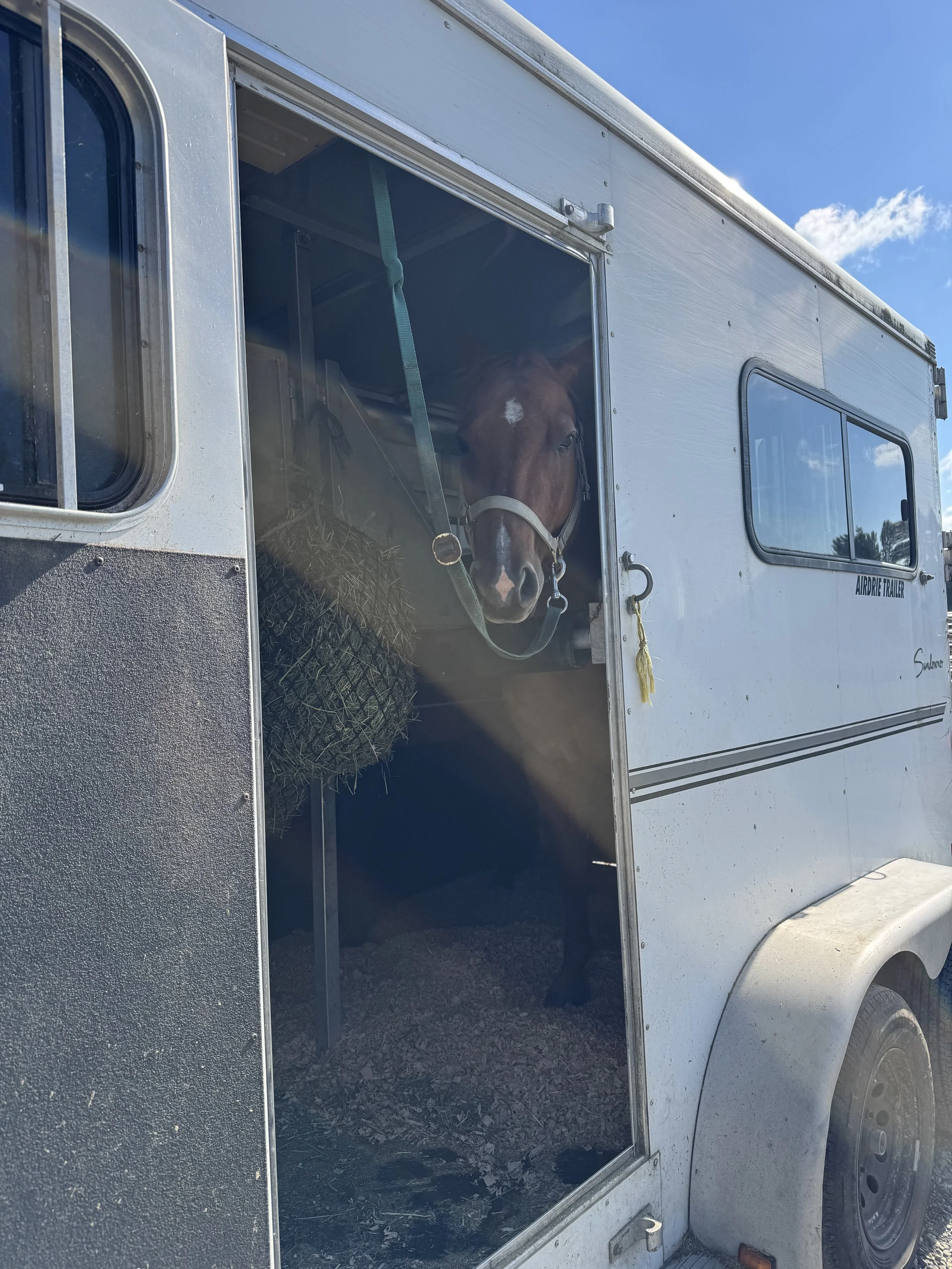
Copper Moving
1. Nurul F. Praharso, Morgan J. Tear, Tegan Cruwys, (2017). Stressful life transitions and wellbeing: A comparison of the stress buffering hypothesis and the social identity model of identity change. Psychiatry Research, Volume 247.
2.Reference: Cohen, N.D., P.G. Gibbs, and A.M. Woods. 1999. Dietary and other management factors associated with colic in horses. Journal of the American Veterinary Medical Association 215:53-60.
3. Williams S, Horner J, Orton E, Green M, McMullen S, Mobasheri A, Freeman SL. Water intake, fecal output and intestinal motility in horses moved from pasture to a stabled management regime with controlled exercise. Equine Vet J. 2015 Jan;47(1):96-100. doi: 10.1111/evj.12238. Epub 2014 Mar 21. PMID: 24528106; PMCID: PMC4303976.
4. Alessandra Tateo, Barbara Padalino, Marianna Boccaccio, Aristide Maggiolino, Pasquale Centoducati, Transport stress in horses: Effects of two different distances, Journal of Veterinary Behavior,Volume 7, Issue 1, 2012, Pages 33-42.
5. Kang OD, Lee WS. Changes in Salivary Cortisol Concentration in Horses during Different Types of Exercise. Asian-Australas J Anim Sci. 2016 May;29(5):747-52. doi: 10.5713/ajas.16.0009. Epub 2016 Mar 4. PMID: 26954193; PMCID: PMC4852239.