
July Blog
Horses, Humans, and Attachment Styles
by Kathleen Choe
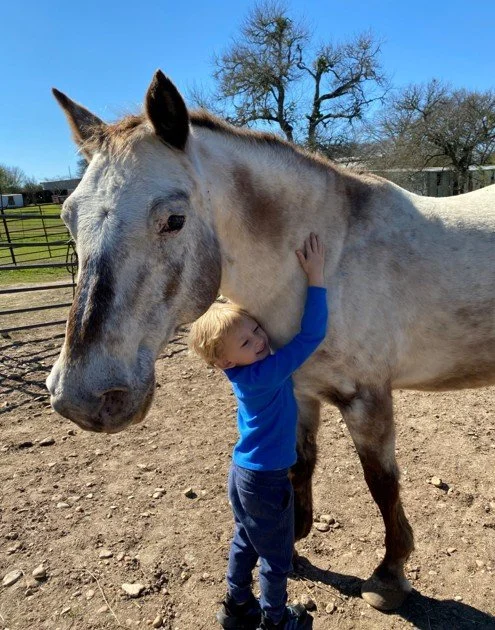
My colleague, Kate Naylor, and I recently did a webinar for HHRF entitled: “The Influence of Our Attachment Style on Horse-Human Interactions,” (you can watch the recording here: https://www.youtube.com/watch?v=JkJD2Djx9io) in which we gave an overview of the four attachment styles, how they are formed, and how they show up in our relationship with others. This a broad and fascinating topic, and there simply wasn’t enough time to go in as much depth as we would have liked, which is why there will be a Part 2 of this webinar topic on November 18th (mark your calendars!) In the meantime, I am devoting the July blog post to furthering a conversation about this subject at the suggestion of my dear friend and HHRF colleague, Terry Boggs.
Our attachment style is an internal map for navigating relational dynamics that begins to develop in utero. As my colleague and Adult Attachment Interview specialist, Jim Harlow, quips, “your attachment style is not genetic, but it may as well be.” Since it develops largely before we have access to cognition and language, we do not “choose” our attachment style; rather, it develops in response to our caregiving environment, as well as being influenced by relatively hard-wired personality traits such as extraversion, conscientiousness, agreeableness, openness to experience, and neuroticism.[1]It is essentially a survival strategy designed to help us get our needs met. If we gestate and are born into a relatively attuned, responsive situation where our needs for protection, safety, attunement, value and support (the Five Pillars of Secure Attachment)[2] are met at least a third of the time, and the rest of the time there is opportunity for relational repair of any ruptures that occurred through mis-attunement, or non-responsiveness, we will develop a secure attachment style, characterized by a stable sense of self and flexibility and resilience in dealing with the inevitable mis-communications and misunderstandings that occur in all relationships.
If the uterine or after-birth environment is marked by unpredictability, volatility, stress and/or neglect (essentially the absence of the sensory input that the developing brain wires in response to), we will develop an insecure attachment style, where we begin leaning either in a more anxious or more avoidant direction relationally. A more anxious or entangled style is characterized by hyper-activation of the nervous system in response to conflict, while a more dismissive or avoidant one is characterized by de-activation of the nervous system in response to conflict.
Babies with an anxious, entangled style, are often labeled “hard to soothe,” because they have learned that once they stop fussing, their caregiver withdraws from them, leaving them feeling abandoned. The primary caregiver may have other children to care for, or be suffering from post-partum depression, or working two jobs to make ends meet, and simply doesn’t have enough emotional, mental and/or physical bandwidth to stay engaged with the infant beyond offering the minimum essential or care such as feeding or changing the baby. The baby learns that remaining in an activated state keeps the caregiver close, and becomes focused on how to maintain connection by constantly pursuing others, exhibiting attention-seeking behaviors that are driven by the fear of abandonment.
Some infants are born into environments where their needs are ignored or not adequately met enough of the time that they learn to “dismiss” a need as soon as it arises. It is simply too painful for their nervous system to be in a constant state of distress. They learn to bypass unpleasant sensations like hunger or pain by dissociating from them. It takes too much metabolic energy to keep crying out if no one is coming to help anyway. Sadly, in many cultures, these babies are labeled as “easy” and “good” because they are no longer “demanding.” Dissociation is often misunderstood as being calm rather than as a form of self-abandonment in order to survive. People with a more dismissive attachment style avoid relational distress by withdrawing rather than seeking connection from others, and focus on being self-sufficient and independent.
Both the anxious and dismissive attachment styles are considered “organized” in that they present in a consistent manner. In other words, the caregiving environment, while poorly attuned, was predictable enough that the infant could develop an organized survival strategy. In the case of the disorganized, or unresolved attachment style, the care-giving environment was not predictable enough that a consistent pattern worked to get the baby’s needs met. This is typically a situation where addiction, abuse, high caregiver turnover and other factors that cause unpredictability and chaos is present in the environment. If infants can’t elicit sustainable care with a particular set of behaviors, they never know what is going to “work” at any given time. People with this attachment style sometimes pursue and other times withdraw in the face of conflict, causing confusion and instability in their relationships.
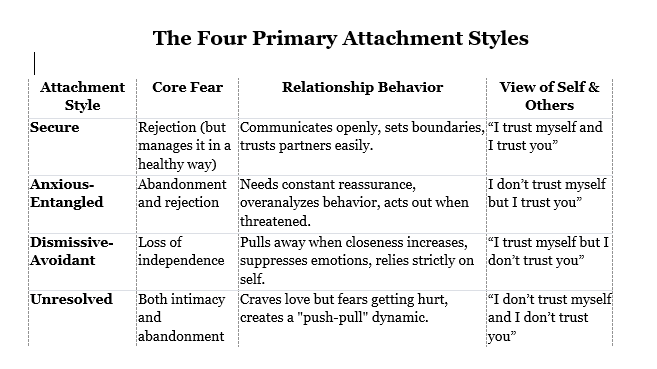
Attachment styles show up on a continuum rather than being strictly fixed. Someone with a more anxious style might start to withdraw a bit in the face of a highly anxious partner, while someone who leans in a more avoidant direction might move towards someone with a distancing pattern. Even a mostly secure individual might pursue (activate) or avoid (de-activate) in highly stressful situations.
How might these different attachment styles affect the way horses and humans interact with each other? This is a fascinating question that we simply ran out of time to adequately address in Part I of our webinar, and will focus on with greater depth in Part 2. An interesting research study recently examined the associations between horse owner attachment styles and personality traits with the following variables: the frequency of their interactions with horses such as riding, groundwork, and spending quality time, as well as headgear choices. The researchers found that higher avoidant attachment was associated with less frequent interactions with horses and greater use of bitted headgear, while higher anxious attachment correlated with more frequent interactions, especially quality time, which was defined as time spent with their horses without any specific demands, and greater use of bitless bridles. [3]
There is surprisingly little research on the attachment styles of horses. Horses have been selectively bred for centuries, and certainly different breeds tend towards particular temperaments and behavior patterns. It is plausible to infer that horses, being sentient beings with their own personalities and relational experiences, would develop their own attachment patterns. This is an important area for more research, which is why HHRF continues to raise money to fund studies that further our knowledge base of how to best care for and relate to our equine friends and support the healing that happens when horses and humans interact in ethical and beneficial ways.
If you would like to support our efforts to explore these and other topics in the field, please visit our website: https://www.horsesandhumans.org to learn more about how you can become involved! And don’t miss Part 2 of our webinar!
[1] https://www.psychologytoday.com/us/basics/big-5-personality-traits
[2] https://www.attachmentproject.com/psychology/ideal-parent-figure-protocol/
[3] Liehrmann, O., Viitanen, A., Ståhl, A., & Salonen, M. (2026). Exploring Equestrian Psychology: How Owner Attachment Style and Personality Traits Relate to Training Choices and Relationship Parameters. Anthrozoös, 1–29. https://doi.org/10.1080/08927936.2026.2676402